Friday, January 14, 2011

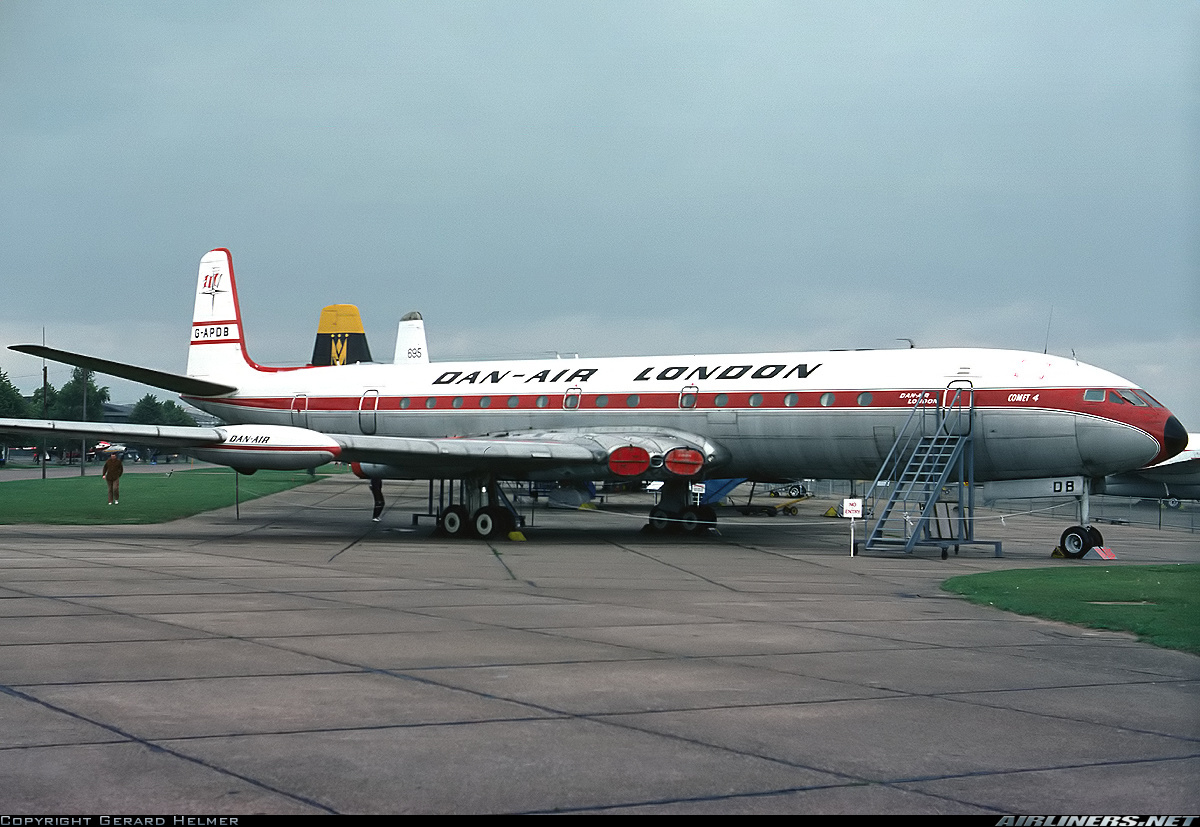
Comet Restoration Moves Forward; Hood Leads the Way

The following article by Stephen Dennis appeared in the November/December 2010 edition of Aloft, a publication of Seattle's Museum of Flight.

Bob Hood loves the Comet; the de Havilland Comet Mk4C, that is, currently at the MOF Restoration Center at Paine Field. He is about to celebrate his 15th anniversary with the Comet restoration team, which he now leads. In nearly 25 years he has amassed over 18,000 volunteer hours and adds another 26 hours working three days each week.


His passion pours forth as he explains the Comets many design innovations as the very first successful jet powered airliner. Structural issues with the first model tarnished its reputation in the industry but failed to alter his opinion.

“This plane was designed by inspired people. Restorers that recognize the creativity of the original builders love to work on this plane,” he says as he points out yet another Comet innovation.

Bob first volunteered on the Boeing 247D in 1986. He believes the 247D was as innovative in the 1930’s as the Comet was in the early 1950’s; one with propellers and the other with jets. One of the highlights of his MOF time was watching the restored 247D take flight.

Bobs’s interest in aircraft restoration developed late in life. In 1965, with a degree in electrical engineering, he joined the leading edge Fairchild Semiconductor Company. He managed their automotive products group exploring ways to integrate new electronic controls in the auto industry.

He did acquire a pilots license and owned a four place Navion “A” followed by an “A” Model Beech Bonanza.
His flying interest took a new course in 1986 when he toured the Restoration Center with a professional group. He was hooked. While he is the current Comet Project Manager he is quick to point out that literally hundreds of individuals have devoted time and energy to the project. In 2002 they did a tally and identified over 125 volunteers who had worked on the plane up to that time. He estimates that more than a hundred names could easily be added to the roster by now. And that doesn’t include the many supporters he has found in the United Kingdom who have helped with parts, advice and encouragement.

His leadership philosophy? Point out what needs to be done and then get out of the way.

The most frequent question he is asked? When will it be done?

The cockpit and first class sections are nearly complete. The aft cabin is coming along nicely. But much remains to be done and, he is quick to point out, new volunteers are always welcome.

When the work is done, the record will be clear that Bob Hood played a big role in its completion.

Air Force One and the Concord; A Docent Love Affair

The following article by Stephen Dennis appeared in the September/October 2010 edition of Aloft, a publication of Seattle's Museum of Flight.

Rick Wheeler loves airplanes. They are in his blood. His late father flew for Hawaiian Air, one brother currently flies for them and a second brother builds planes for Boeing.

A developmental disability keeps Rick from flying planes but nothing can keep him away from them. In five years at the MOF he has amassed over 500 volunteer hours. Most of that time has been spent in the Air Park where he devotes two days a week to cleaning either Air Force One or the Concord. Rich Lynch, Air Park Lead, reports that, “Rick is hard working, reliable and very fun to work with. On Air Force One days Rick wears his Air Force One hat and conducts a pre-cleaning walk around the plane in pre-flight fashion. On Concord days he always arrives in his British Air jacket.”

One day, when the Plexiglas was removed for cockpit cleaning, Rick posed in the Air Force One pilot’s seat in a cowboy hat doing his best LBJ imitation. He is particularly proud of that photo.

It’s a 90 minute bus ride from his home to the MOF so Rick makes the most of his time upon arrival. Following his Air Park work he is often found in the control tower or the Personal Courage Wing. His current favorite in the PC Wing is the P-51 and he is saving his money to fulfill a dream in 2011; a flight in the B-17, Liberty Bell.

His volunteer work around the biplane concession has earned him several rides over Seattle and he gives each of his nieces and nephews a biplane ride upon graduation from high school. He has even done a tandem jump from a plane in Hawaii.

His plane passion continues when he is away from the MOF. He maintains a museum quality collection of aircraft and airline pins which he once displayed in the hobby area of the Puyallup Fair. He collects tail numbers in little spiral notebooks and, according to Lynch, if you want to know anything about a particular plane, just give Rick the tail number.

Rick Wheeler, with the support of his “flying family,” demonstrates there are no limits to the volunteer opportunities at the MOF.

Thursday, September 23, 2010

Museum of Flight; Support for Aviation Education

This article appeared in the July/August issue of "Aloft" a publication of Seattle's Museum of Flight.

The Museum of Flight is dedicated to serving learners of all ages. To maintain an “educational edge” Museum leadership depends on the thoughtful and enthusiastic input of the Educational Leaders Advisory Board or ELAB. Made up of educators, government and industry representatives, ELAB volunteers devote countless hours to the Museums educational programs and have played a valuable role in keeping the programs fresh and focused.


Michael and Jessica van Son, brother and sister, bring two very different perspectives to the ELAB and illustrate the type of talent volunteering their energy to the board.

Combining a business degree with a love of science Michael works as a metrologist with Lockheed Martin in Silverdale, Washington. In addition to his ten years on the ELAB he volunteers hundreds of hours with Kitsap County school science initiatives.

According to Seth Margolis, Director of Education Programs for the Museum, “Michael represents the aerospace/engineering industry on ELAB. He brings that big picture view point to the board. He understands how our programs intersect with the industry side of the education and guides us to consider their role in the larger field---that student experiences at the Museum are not simply static but that they lead into further discovery and inspiration to explore the STEM fields as careers.”

Jessica, a Longview area special education teacher, brings her students on an annual visit to the MOF. Four years ago she was encouraged to join the ELAB to bring her energy, interest in scientific education and understanding of special needs students to the Museum.

“As a teacher, Jessica brings a formal education perspective to ELAB,” said Margolis. “She can view our programs from the end-user side of the equation. She understand how they relate to the school system and what we need to do to ensure that they meet the scholastic needs of the audience while also being enjoyable, rigorous, and age appropriate. She allows us to hear directly from our constituents. Jessica has also been a Washington Aerospace Scholars residency program counselor for two years and thus is intimately involved in all of our programs.”

The most visible Museum volunteers are the docents who are present in the Museum everyday, interacting with visitors. The ELAB volunteers perform their service “behind-the-scenes” to insure the educational component of the Museum vision stays relevant for the regions life-long learners of all ages. Jessica and Michael are excellent examples of the quality and passion of the ELAB members.

Wednesday, June 23, 2010

The B-17; A Labor of Love

This Volunteer Profile appeared in the May/June 2010 issue of "ALOFT," a publication of Seattle's Museum of Flight. It honors the many volunteers who have worked to restore a vintage B-17 for the Museum's collection.

Since its first flight the B-17 has been an icon on the Boeing and the Seattle area aviation scene. Even now, 75 years later, you don’t have to look far to find a Museum volunteer whose life has been touched by the big plane.

Velva Maye, for example, has been working on the restoration of the Museums B-17 since it was acquired in 1991. Why the interest?

“Because my parts are on that plane,” she replies.

In 1942, at age 18, Velva joined Boeing as a “standard parts buyer” for the B-17 program. She’s confident her nuts, bolts and rivets are holding the Museums plane together. The work was exciting for a young woman. When an “SOS,” shortage of supplies, was sent up from the shop floor Velva would, at times, end up shuttling parts from one part of the plant, where there was a surplus, to relieve the shortage. That was the start of a 40 year career with Boeing.

She and other “lady restorers,” like Jean Almeda and Linda Broyles, handled whatever assignments were sent their way; sanding, painting, record keeping, etc. Velva recalls another volunteer, Sarah McDonald, who seemed to get all the “crummy” jobs; treating metal parts in foul smelling solvents, for example. But she and the others stuck with the program.

Early in the restoration Velva had the good fortune to work with the late Roy Ostling, one of the original engineers for the B-17 program. Roy had worked on every model of the plane from the “B” through the “G” models.
“Roy knew that plane down to the smallest detail. He insured that all our work matched the original design in every respect,” said Velva.

Walter Bergstrom, a five year Docent, had a different view of the B-17; from the ball turret slung beneath the belly. Walter volunteers every Friday and enjoys telling of his wartime B-17 experiences. He particularly enjoys working with kids.

He joined his crew as a waist gunner but, since “they had trouble keeping guys in the ball turret,” he volunteered to switch. At 5’ 10” he was a bit tall for the turret but found it comfortable and the view was spectacular. As his bomb group formed up he would curl into the turret and stay there until they left the continent on the return flight; six to eight hour stays were not unusual. Once in the turret he was the pilot’s eyes below and behind the plane. With so many planes maneuvering in a small space his view was critical. It was so snug that he had to leave his parachute up in the plane.

Walter arrived in England in April, 1944, in time to give the British support during D Day. His squadron carried out attacks on Caen in advance of the British. Unfortunately for Walter, he had one more take off than landing. On his 24th mission their plane experienced a serious wing fire and struggled to make England. On final approach Walter and others in the rear decided to jump. The handle on the escape hatch caught on his cuff and stayed with him all the way down. Due to the low altitude his chute barely opened and he landed badly in a dry swampy area. Two local boys made him comfortable on the ground, stole two packs of Chesterfields, and left him for later rescue.

His early exit broke 16 bones, including his back and both legs, and started him on a yearlong rehab in the states. It also earned him a membership in the “Caterpillar Club,” sponsored by the Irving Air Chute Company and open to flyers who used their parachutes in an emergency. Walter is proud of his club membership and, despite his bail out, still swears by the B-17.

“Everyone wanted to fly the B-17. It was the best. Four years ago I got to go up again; this time in the “Aluminum Overcast” when she visited Seattle. But at 210 pounds I don’t fit in the ball turret any longer!”

Docent Ted Gary enjoyed a different view, as a tail gunner on 22 B-17 missions beginning in January of 1945. He was always looking back. Late in the war German aircraft were scarce but the flak never let up. Ted took little comfort from the fact that the canvas gunner enclosure of the “F” model had been replaced by thin aluminum on his “G.”. His kneeling position was cold and cramped and his parachute had to be kept “nearby” during the long flights.

Near the end of hostilities he flew two “chow hound” missions, dropping food from 400 feet over occupied Holland. He can still recall the sight of Dutch civilians running past silent German gun positions to recover the falling food. Since the bomb bay food release system was unreliable some of the pallets fell far from their intended targets.

“I was afraid we’d kill civilians with food canisters,” he said.

During a later vacation in Holland he was nearly smothered by a thankful Dutch woman when she learned that he’d participated in the food drop that saved many lives.

Hank Hendrickson both piloted a B-17 and, since 2004, has been active with the restoration of the Museums plane. Hank picked up a new B-17 in May of “44” in Georgia and by June was flying the first of his 30 European missions. His appreciation of the rugged plane was enhanced on a mission over Germany when flak ripped a massive hole aft of the bomb bay, killing three crew members and sending the plane into a roll. With all engines still firing he regained control and diverted to a secondary target not fully appreciating how badly damaged the plane was. After inspecting the damage they aimed for an emergency field on the English coast and, confident the stress of landing would break off the tail, he ordered the tail gunner to jump before executing a successful landing. The chilly tail gunner was recovered uninjured.

Hanks extensive combat time has made him an ideal tour guide for visitors to the Museums restored plane.

Not all of the Museums B-17 aficionados had wartime contact with the big plane. Herb Phelan, for example, didn’t make serious contact with the program until 1993, following a career in aircraft design at Boeing. Looking for a retirement activity he became hooked on the restoration project and, since 1999 has served as project manager or crew chief for the project. He recently took over the B-29 restoration as well; and all as a volunteer!

Organizing volunteers to do anything can be a challenging task but, from the results and comments of other volunteers, it is clear Herb was the right man for the job. Under his leadership the restoration volunteers strive for authenticity in their work which continues to this day. Using the original production drawings they have fabricated hundreds of parts and systems to bring the plane back to “factory” condition. When a lack of castings or tooling prevent perfect replicas they adapt to achieve the “look and function” of the original parts.

For example, with Herb’s direction, Alan Peover, another volunteer, recently installed a windshield wiper assembly for the bombardier position. Using original drawings new parts were fabricated and matched with authentic components purchased on-line to bring the installation up to factory specs.

In addition to fabrication skills Peover has found agility to be an asset as well. To install pulleys, cables and brackets for an “emergency cable release for the bomb bay doors” Peover had to remove floorboards and squeeze his body into nearly inaccessible compartments.

Peover is now fabricating ten simulated 500 pound bombs for installation in the planes empty bomb bay. Many hours will be spent fabricating fuses, fins and other components based on design drawings acquired from a source in Great Britain but, in the end, they will look like the real thing and further enhance the accuracy of the restoration.

The list of involved volunteers could go on and on; Loody Christofero and many other have invested countless hours in the B-17 program. The Museum is fortunate to have such skilled and dedicated volunteers. Future generations who want to see a truly authentic restoration will benefit from their commitment and hard work for decades to come.

Marquita Fortner; Aviation as a Family Tradition

This Volunteer Profile appeared in the March/April 2010 edition of "ALOFT," a publication of Seattle's Museum of Flight.

Marquita Fortner has been described as “an accomplished young woman.” That may be an understatement. In just two years as a Docent, working Saturdays and every special event she can squeeze in, she has amassed 262 hours of volunteer time. Why?

“It’s a great place to share my love of aviation, its history, people, planes and companies,” she replies.

Aviation is in her genes. Both parents are private pilots and Marquita flew a plane before she drove a car. She is a graduate of the New Mexico Military Institute, Embry-Riddle and has a Masters degree in transportation policy from George Mason University. She is employed by a consulting firm that supports the air cargo industry and will soon receive her commission in the U. S. Navy reserve. She is a busy 27 year old!

She enjoys all her Docent time at the museum and particularly enjoys speaking with young people about opportunities in the aviation field. Two museum encounters have been particularly memorable. Working the 2009 gala she met and was photographed with her “all time favorite” astronaut, Charles Duke, the lunar module pilot on Apollo 16. (Who landed on the moon a full decade before she was born!)

On another occasion, while giving a Tip-to-Tail presentation on the F-104, she met an “F-104” pilot and his daughter. The daughter returned later to thank Marquita, indicating her presentation had caused her dad to open up about his flying experiences like never before.

“It meant a lot to me to see how the presentation helped the daughter to learn more about her father. He’d ejected from two F-104’s and ended up marrying one of the crash investigating officers. He also served as an SR-71 test pilot. What a flying career!”

Though her Naval Reserve duties will take her from the museum some weekends she still plans to stay as involved as she can. Starting so young, there is a good chance she will set new records for volunteer hours. She is off to a good start.

Friday, October 16, 2009

Cycle Idaho; The Hiawatha and Coeur d'Alene Trails

Idaho offers wonderful bike trails, set in the mountains on old rail lines with only moderate grades. To read about two of the most popular, the Hiawatha and the Trail of the Coeur d'Alenes, visit Steve's Travel Journals.

But don't pack your bikes just yet. Snows have come to the high country closing the higher trails. Instead visit the site for inspiration and planning for 2010. Enjoy.

Friday, June 26, 2009

Old Seventy; Requiem for a B-17

This article, based on a relative's personal notes and official records, appeared in the June 2009 edition of "Warbirds Magazine."

Over 12,000 B-17 variants were produced during World War II. Only a few, like the Memphis Belle, have left deep tracks in the sands of history allowing historians to follow their movements during their often brief life in the Army Air Corps. Of the “B” series only one, serial number 38-215, has left a significant trail.

Through letters, personal journals, after action reports and government records 38-215, later nicknamed “Old Seventy,” can be followed from her November, 1939 delivery at March Field to her fatal Aleutian crash July 18, 1942. During her life she played a number of roles: test platform for cold weather operations, patrol plane under Navy control, bomber and weather reconnaissance aircraft.
The B-17B series was born in the middle of the depression when the Army had to beg for each development dollar from a reluctant Congress. A direct descendant of the model 299, launched in 1935 and the 13 YB-17s, ordered for testing in 1936, the “B” series included a number of design upgrades including superchargers, a larger tail, new nose, hydraulic brakes and revised gun and bombardier positions. It is arguably the first “production” version of the B-17 and the first assigned to active bombardment groups; one on the Atlantic coast and one on the Pacific side. Only 39 B-17Bs were built and none survived the war yet they made a valuable contributions to the further development of the “C,” “D” and ultimately the first model worthy of the “Fortress” moniker, the “E” series.
Old Seventy spent the first months of her career in California, between March Field and the Sacramento Air Depot. In early 1940 orders were issued for the transfer of Old Seventy and her sister ship, 38-216, to the new Army Cold Weather Test Detachment at Ladd Field (now Fort Wainright), then under construction near Fairbanks, Alaska. The detachment would be charged with testing aircraft, equipment, maintenance procedures and other Army gear in the frigid northland. While bush and commercial pilots had been developing skills for Arctic flight operations, the Army lacked cold weather experience.
Old Seventy, 38-216 and the Cold Weather Test Detachment (CWTD) would provide that knowledge.
On April 14, 1940 Major Dale Gaffney, Lt. Marvin Walseth and 16 others were detached to Ladd to pave the way for aircraft and technicians to follow. They arrived to find a field under construction so set up their first operations in nearby Fairbanks.
At March Field technicians went to work on the two Alaska bound B-17Bs to prepare them for their Arctic assignment. Guns and bomb racks were removed, replaced with test equipment. Day-glow orange was applied to the wing tips and tails of the silver birds and a new symbol, a bomb carrying polar bear, was applied to each fuselage. Old Seventy received a large “1” on the fuselage and smaller one on the tail. 38-216 received a similar “2.”
On October 4, 1940 the two planes departed March Field carrying six officers and eighteen men. Arriving at Ladd bundled in heavy parkas they were surprised by the moderate fall weather and the lack of snow. They would soon learn why Fairbanks was selected as the cold weather test site.
Anchorage based General Simon Buckner, newly assigned Commander of the Alaska Defense Forces, favored the big plane for his frequent aerial tours and soon the planes were making appearances at remote fields all over the territory. While single engine bush planes were common, the big bombers were a novelty in the north. They were so noteworthy that on several occasions in October and November the Anchorage newspaper reported on the arrivals and departures of the planes. In one case they noted it “stayed on the ground for 15 minutes.”
In addition to testing work Old Seventy made frequent trips to Alaska’s interior, inventorying available landing sites for use in flying emergencies and in time of war. At then end of November Lt. Walseth, Gaffney’s adjutant, flew to Fort Yukon and then out over the Arctic Ocean. On December 1st he was off to Nome to pick up fur parkas and mucklucks locals were making for the Army. In a letter home he reported…“believe me, it was a great treat for all the people over there and for all of us as the field was rolly and not a foot too long. We just got in and off.”
The winter testing had fallen into a routine when tragedy stuck the small Ladd flying community. In early February Captain R. S. Freeman flew 38-216 to the Sacramento Air Depot with reports concerning the winter flight operations at Ladd. On February 6th, enroute from Sacramento to Wright Field, the plane crashed into a Nevada mountain killing all aboard. Old Seventy was now the only four engine bomber operating in the Alaska Territory.
Later that month Lt. Walseth filed a report of the first year’s activities of the Ladd CWTD. He reported that Old Seventy had flown over 324 hours in just six months at temperatures ranging from -47 degrees to +50 degrees F. During that time a number of changes had been made to the aircraft including the installation of:
· 1000 watt engine oil immersion heaters.
· A B-17C style cabin heating system with boiler units on two engines. (First orders for the “C” series planes had been placed in July of 1940)
· Six outlets for heated flying suits.
· 100 amp, type E-85, generators replacing the 50 amp models.
· Defroster for bombardier’s aiming window.
He also reported on the testing of electric flying suits from General Electric and United States Rubber. Flight crews had found them wanting for Arctic use. One had caught fire. All had cold spots and failed to maintain temperature when the generators were not producing while idling on the ground. Worse “…if a man had to leave his ship…a man with good emergency equipment and good non-heated flying clothing would have a chance of surviving….A man in … electrically
heated outfits would be helpless….”
On April 30th Ladd nearly lost its remaining B-17B. As Walseth reported after a night flight, “Almost had to leave it [the plane] as the propeller governor broke and the engine ran away. Tore itself all to pieces, cylinder broke off, etc. In fact almost completely demolished. That is about the worst experience I have had.”
Grounded until a new engine could be shipped to Ladd her next trip didn’t occur until the end of May when Old Seventy flew at 15,000 feet non-stop to Sacramento making the 2400 mile flight in eleven hours. At Sacramento she received a complete overhaul and some features from the “C” series were added. The most visible change was the replacement of the “tear drop” gun blisters on the waist with flush mounted openings that produced less drag and gave better gun angles.
After nearly a month on the ground Walseth completed Old Seventy’s trip to the lower ’48 via San Antonio, Maxwell Field and Wright Field in Dayton. In July she returned to Ladd to enjoy the last months of peace on the northern frontier.
When war was thrust upon the United States, December 7th, 1941, Old Seventy was one of the few more modern aircraft available in the Alaska territory. But since the CWTD reported directly to Wright Field, General Buckner didn’t even include it in his aircraft count. On January 3, 1942 Buckner advised Army Headquarters that “There is not at the present time a single up-to-date fighting plane in the Alaska Defense Command.” The best he could muster were “seven obsolescent medium bombing planes [B-18s] and sixteen equally outmoded pursuit planes. [P-36s]”
As 1942 progressed the Anchorage based 36th Bombardment Squadron began cobbling together a fighting force. Old Seventy was transferred to the 36th. In March a single B-17E arrived from Wright Field followed in May by three LB-30s, an export version of the B-24. All but Old Seventy had rudimentary radar. This was the air fleet ordered to the NW Sea Frontier Command at the Kodiak Navy Base in late May. The same intelligence intercepts that set up the Midway battle included warnings of a Japanese attack on Alaska. The question was, where would it occur?
Old Seventy arrived at Kodiak with Lieutenants Jack Marks and Richard Ragle at the controls. The crew was given a top secret briefing and informed they were to be assigned to Navy Patrol Wing 4 and operate from to a new, secret base on Umnak Island in the Aleutian chain. But their mission had been so secret that they’d departed Ladd with a sick engine and without bombsight, bomb shackles, guns, ammunition and other essential fighting gear. Before she could go to war she had to be converted from a test platform to a fighting ship.
She returned to Ladd on May 26th and, with ground crews working 24 hours a day, finally arrived at Umnak on June 2, ready to join the fight.
For the next six weeks Old Seventy would be in almost constant motion. The day they arrived at Umnak they were fueled, armed and, at 1800, sent on patrol looking for the Japanese fleet. Aleutian weather, which haunted most flights, forced her to fly under the 400 foot cloud ceiling. Returning at 0530, the third, they learned of the Dutch Harbor attack, refueled and took off again.
With Marks and Ragle at the controls they ran into Japanese planes returning from Dutch Harbor and the waist gunner, Sgt. K. E. Nelson, claimed a kill. He also put 50 holes in the tail of Old Seventy! Flying beneath the 250 foot ceiling they followed the retreating enemy planes and came upon what they believed was the entire Japanese fleet. They dropped their bombs under heavy clouds and returned to base.
The next few days Old Seventy was in the air more than on the ground chasing phantom fleets over the unforgiving waters. At one point she nearly attacked an island rising from the foggy mists.
On June 4th she lost her bomb bay doors when her bombs released following a violent maneuver to avoid a cloud shrouded mountain side. Later they were forced to shut down number two engine when the cowling worked loose and nearly caught the propeller. While flying at reduced speed they were jumped by Japanese planes. Only the dense cloud cover allowed them to avert disaster.
By the 6th of June the constant flying was taking a toll on her. After an early morning patrol, departing at 0435, followed by a mid-day patrol, departing at 1150, she was serviced and in the air again at 1545. Shortly after takeoff one engine failed. She turned toward Anchorage on three engines with two generators out, severe icing and two superchargers acting erratically. More generator problems finally forced Old Seventy down at the small village of Naknek at 2320.
They made emergency repairs and returned to the fight only to be disabled on the 7th by a faulty fuel transfer pump, disabled during an earlier encounter with a Japanese fighter.
On the 9th she was assigned on a bombing run to Kiska, where the Japanese were establishing a base. Old Seventy’s problems began to mount. She was too old and slow to keep up with the B-24s that were arriving to expand the strike force. Only by pushing her to the limit could she keep up with the newer, faster, planes. She made the trip on the 9th but, on the 10th, number two engine failed and she had to abort. A ground check revealed that two cylinders lacked compression. She needed a new engine and the nearest spare was at Ladd.
She returned from Ladd sporting new Army green livery, replacing the international orange paint job from her testing days. Since she was not in the same league as the newer bombers she was given a new and important solo role, weather reconnaissance and redesignated YB-17B. Weather was a nightmare in the Aleutians; low ceiling, fog, high winds. Worse, storms came from the west so flights taking off from Umnak had no idea what they would encounter on their 600 mile flight to Kiska. Old Seventy’s new job was to serve as lead scout feeding weather information back to base operations.
Former Lieutenant Walseth, now Major, took over Old Seventy in July. The pace for both aircraft and crews remained grueling. In a letter to his family Walseth reported that, “Most of our flights run around ten hours. Sometimes two or three in succession but when possible every other day. After three successive flights it takes about a week to recover, which none of us get. So we are generally quite worn down. The war we are fighting up here is a long slow process as everything depends on the weather. All the fronts move toward us so the [Japanese] sort of have an edge on us as they know what’s coming and we don’t.”
And the grind continued. Out shown by the newer, faster models, Old Seventy continued to contribute to the fight in her own, independent way. Finally, on July 18 she failed to return from a solo photo reconnaissance mission. The old lady was gone.
The diary of Lt. Billy Wheeler, of the 36th Bombardment Squadron, describes what happened. “The weather at Umnak [on the 18th] was bad as usual. The visibility was as low as 100 feet and a sea fog surrounded the island during the greater part of the day. Several days after the report of the loss, Major Walseth’s ship was found on Cape Udak, the Southwest end of Umnak Island…[The crew was] buried near the Nikolski village, a short distance from the crash scene. These were the only burials in the squadron, bodies are rarely found in our job. It was assumed that Walseth had made a landfall on Umnak and had endeavored to follow the coastline to the field. An unexpected land projection caught him. He crashed only twenty feet from the top.”
Old Seventy’s contribution to the war effort ended 32 months after it began in the California sunshine. Piloted by a succession of young men she provided valuable lessons concerning the operation of aircraft in cold climates. The groundwork she and her crew laid made life easier for those who followed and helped insure the other 12,000 B-17 aircraft truly performed like “Flying Fortresses.”

Origin of the Name “Old Seventy”

The origin of the name “Old Seventy” remains a mystery.

Major Walseth, the pilot on its ill fated last mission, never refers to the name in his correspondence. He flew the plane extensively from its arrival in Alaska in October of 1940 until the Pearl Harbor attack. In early 1942, with many pilots and only one plane, other pilots were often at her controls. In May of 1942 Captain Marks flew her on her first combat missions with Lt Ragle as co-pilot. Both Marks and Ragle refer to her as Old Seventy as do authors who wrote extensively about the Aleutian campaign.
Ragle, who survived the war, suggested that the name may have come from a radio call sign given her by the Navy during her brief stint as a Navy patrol plane in late May and early June of 1942. Even he couldn’t recall specific details.
But the name stuck. And Old Seventy, the only “B” series bomber to see extensive combat action following Pearl Harbor, will live on in history with that moniker.
Where Are They Now?

Major, later General, Gaffney remained in Alaska and took over responsibility for the Ferry Command which managed the Lend Lease program that was ferrying planes to Fairbanks where they were turned over to our Russian allies.
Lieutenant, later Captain, Ragle returned to Ladd Field and played a major role in the Ferry Command under Gaffney.
Both Gaffney and Ragle survived the war.
Lieutenant Wheeler, who left behind an extensive diary of the 36th Bombardment Sq. activities, survived the Aleutian campaign and returned to Seattle with the remnants of the Squadron after it was disbanded following victory in the Aleutians. The author has no record of his other war time activities.
Major Marks and his crew perished in a B-17E shot down on a July 17 raid over Kiska.
Major Walseth and his crew perished on a remote corner of Umnak Island the next day.
General Buckner went on to lead the 10th Army on Okinawa where he was killed in action.